
Third shutdown of the shift and it is not even 11 AM yet. Frequent shutdowns caused by wire wrapping around the rotor are the most common operational problem in tire shredders, and in most cases the cause is not maintenance or adjustment, but the mechanical principle of the equipment itself. In this article, we will analyze why high-speed single-shaft shredders cannot process the ductile steel in radial truck tires, how low-speed shear cutting solves this mechanism, and what the real impact of shutdowns is on the operation’s productivity and revenue.
Why tire steel wraps around the rotor
Radial tires are not pure rubber. They are composite structures with 15% to 25% steel by weight in truck models. The steel is distributed across three regions: the beads (wire rings of 1.2 to 1.6 mm diameter that secure the tire to the rim), the belts (steel cord strips under the tread), and the carcass (plies with steel cords in radial truck tires).
This steel has high ductility. It does not fragment on impact. When subjected to tension, it deforms and stretches before breaking. And it is this mechanical behavior that determines what happens inside the shredder.
In single-shaft shredders with high rotation speed (typically 200 to 400 RPM), the rotor spins fast enough to pull the wire before cutting it. The wire elongates, wraps around the shaft, and accumulates turn after turn. Within a few cycles, the accumulated volume blocks the chamber, forces the motor into thermal overload, and trips the protection. Shutdown. Open up. Manual removal. Restart. And the cycle begins again.
The natural reaction from operators is to try adjustments: harder blades, slower feed rate, different rotation speed. None of these adjustments change the fundamental mechanism. A high-speed rotor with a single shaft will always pull ductile wire instead of cutting it. This is a design limitation, not an adjustment issue.
How low-speed shear cutting solves the problem
Four-shaft shredders operating at low speed work on a different mechanical principle.
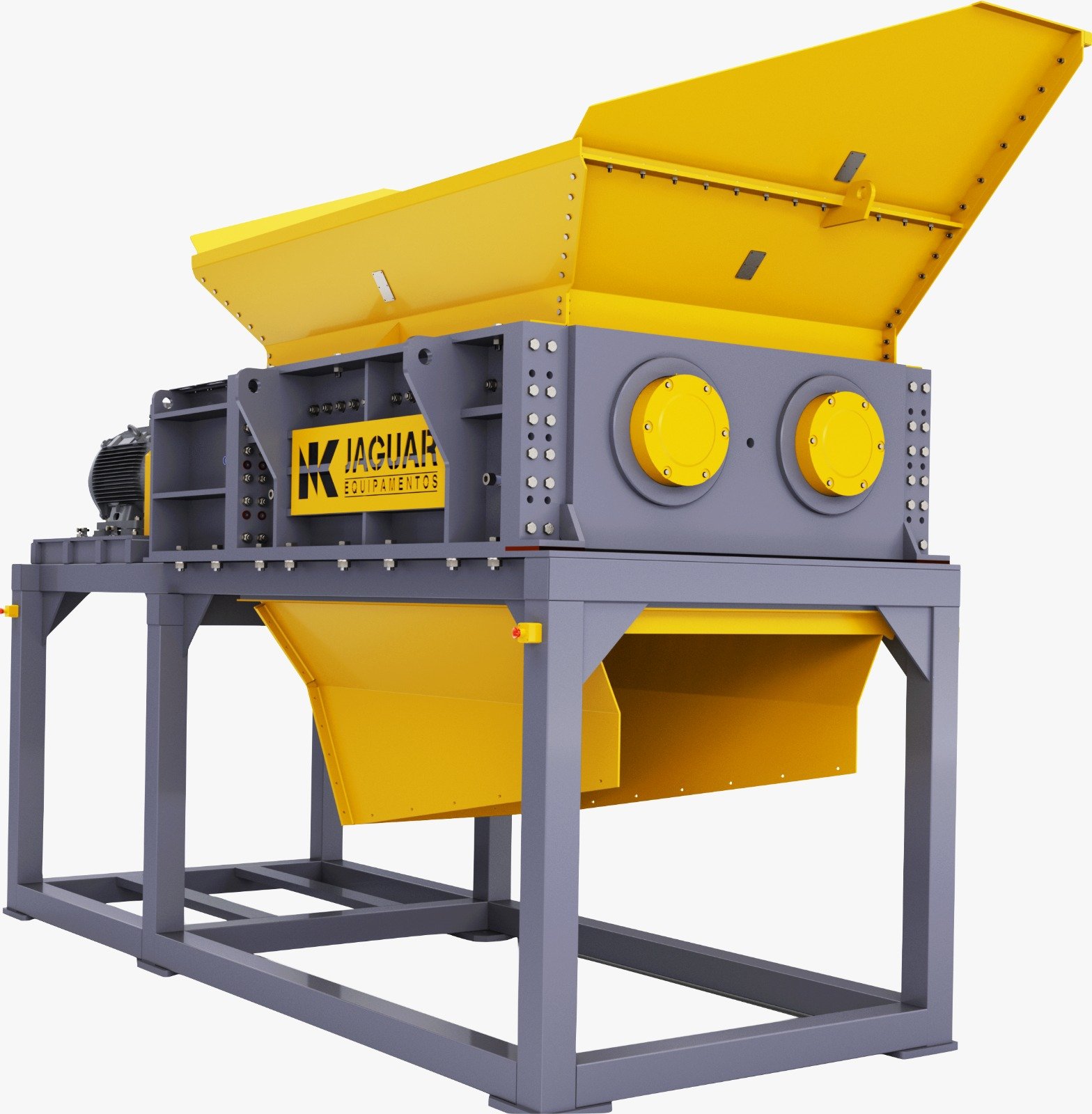 The shafts work in counter-rotating pairs, spinning between 15 and 25 RPM. At this rotation range, there is not enough inertia to pull and stretch the wire. Instead, the blades on adjacent shafts create a shearing effect: the material is sectioned between two crossing edges, like scissors.
The wire is cut into short segments, shorter than the blade spacing. Short segments do not have enough length to wrap. They are expelled together with the shredded rubber.
When a truck tire bead enters in an unfavorable position, the system has a second layer of protection. The mechanical anti-shock clutch detects the torque increase and decouples before any damage. The automatic reverse repositions the material. The line resumes on its own, without operator intervention.
In practice, a 4-shaft shredder with 400 hp processes 5 to 8 t/h of whole tires without unplanned shutdowns. A single-shaft unit of similar power processing the same material, with 20 shutdowns per shift, delivers an effective 2 t/h.
The lost productivity calculation
The math is straightforward. Consider an operation with two 8-hour shifts, 20 days per month:
Three 30-minute shutdowns per shift total 3 hours of machine downtime per day. Over 20 days, that is 60 hours lost per month. At a nominal capacity of 5 t/h, that represents 300 tons not processed. With tire chips sold between R$ 80 and R$ 150 (Brazilian Real) per ton to cement plants, the lost revenue is between R$ 24,000 and R$ 45,000 per month from shutdowns alone.
This calculation does not include accelerated wear on blades and bearings from overload, elevated energy consumption during startups and shutdowns, and corrective maintenance costs. The real cost of shutdowns almost always exceeds the cost of replacing the equipment within 12 to 18 months.
If the operation’s shredder stops more than twice per shift on tires, a replacement analysis is justified. It is also possible to rent equipment to test the operation before investing.
Jaguar Industrial evaluates the existing operation, measures shutdown frequency and duration, and estimates the return on replacement before making any equipment proposal.
Talk to engineering -> · WhatsApp ->
The difference between a shredder that stops 20 times per shift and one that does not stop at all is not blade quality or operator skill. It is the mechanical cutting principle. Low-speed shear cutting cuts ductile steel. High-speed impact wraps it.