
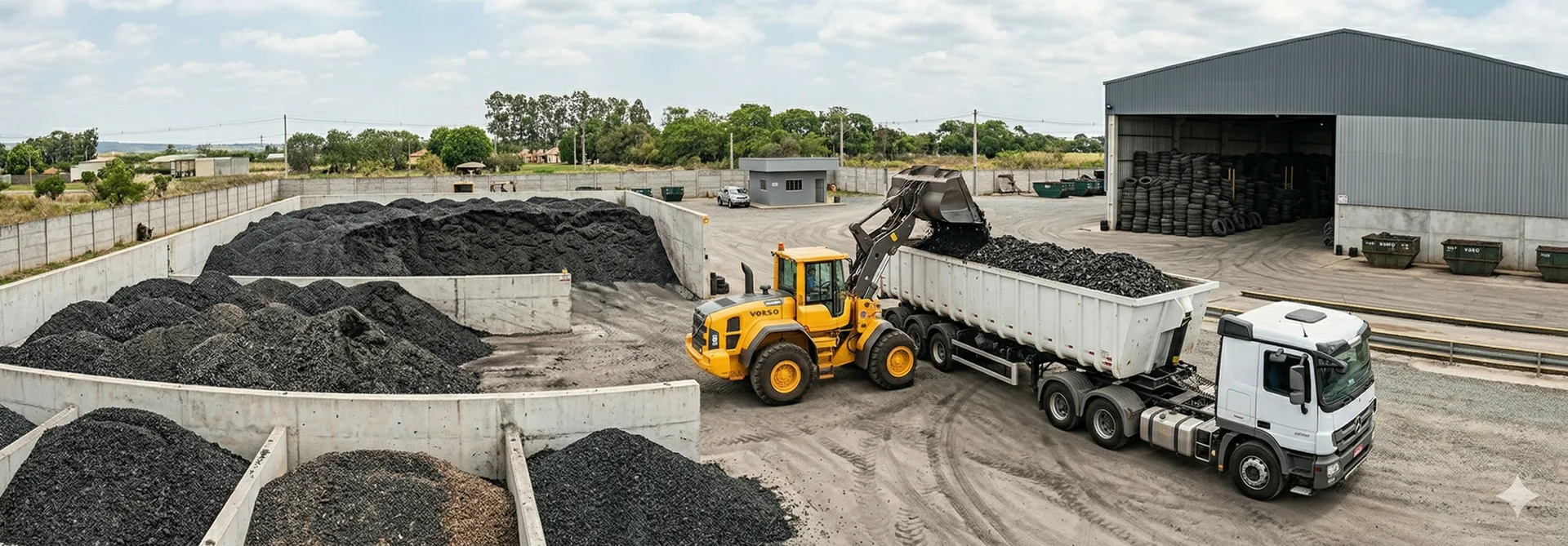
28 tons of tire chips leave Campinas at five in the morning, and at the cement plant gate the load is rejected for 120 mm fragments when the contract specifies a maximum of 50 mm. This situation, which costs between R$ 8,000 and R$ 20,000 (Brazilian Real) in wasted freight per trip on top of unrealized revenue, happens more often than it should and almost always has the same root cause: absence of a calibrated screen in the shredder or unmonitored wear. In this article, we will analyze why the cement plant requires a maximum particle size, which shredder component controls this dimension, and how a simple measurement routine eliminates rejections in practice.
Why the cement plant specifies maximum particle size
The cement plant does not buy tire chips out of environmental goodwill. It operates under an operating license issued by the state environmental agency, which specifies exactly which waste materials can enter the kiln and under what conditions. The maximum chip dimension is one of those conditions. It appears in the supply contract, in the license, and in inspection records.
The technical reason is the kiln’s feed system. Chips enter via conveyor belts and dosing systems that were designed for a specific particle size range. Chips above the maximum size cause three problems: they jam the dosing systems, they burn incompletely inside the kiln (generating emissions beyond permitted levels), and long wires wrap around conveyors and shut down the production line. A kiln shutdown at a cement plant costs tens of thousands of reais per hour. The cement plant will not accept that risk.
The typical specification for tire chip co-processing in Brazil is 50 mm maximum, with residual steel content below 5% and moisture below 3%. These parameters vary between plants, but that is the general range.
The component that controls particle size
The component is called a screen (or grate): a perforated steel plate positioned below the shredder rotors, present in 4-shaft Series Q shredders and in the D57 for tires.
 The principle is simple. No fragment leaves the cutting chamber before passing through the holes. The maximum chip size is defined by the screen opening.
With a screen calibrated to 50 mm, the material circulates in the chamber until it is reduced enough to pass through. Passenger car tires, truck tires, OTR tires. The tire type changes the processing time, but it does not change the chip size at the output. The result is consistent batch after batch.
Without a screen, the shredder produces whatever the blade geometry and feed allow. The particle size range becomes wide and unpredictable: 30 mm fragments mixed with 120 mm pieces in the same batch. Long wires pass through intact. The batch may pass inspection one day and be rejected the next, depending on how the material distributed in the container.
Most rejections at the cement plant gate have this origin. It is not the tire. It is not the operator. It is the absence of a screen or a screen with the wrong opening size.
The wear nobody monitors
Screens are wear parts. The constant friction of material against the hole edges widens the openings progressively. A screen calibrated to 50 mm can be passing 55 mm after 800 operating hours and 60 mm after 1,200 hours, depending on the material processed and the plate composition.
The problem is that this wear is gradual. Batches keep passing the cement plant’s inspection until the day they do not. The operation only finds out when it receives the rejection, and at that point the wear has been accumulating for weeks or months.
Two checks solve this. First: does the shredder have a screen installed? If not, there is no particle size control. The chip comes out whatever size it comes out. Second: when were the screen holes last measured? Holes with wear beyond tolerance deliver out-of-spec chips even when the operator is doing everything right.
The recommended practice is to measure screen hole openings every 400 operating hours and replace the screen when wear exceeds 10% of the nominal dimension. For a 50 mm screen, the replacement threshold is when holes reach 55 mm. Replacement parts and blade resharpening are part of the preventive maintenance program.
How to prevent rejection in practice
Quality control in tire shredding operations depends on three points: a screen with the correct opening for the buyer’s specification, a periodic wear measurement program, and chip sampling before loading with maximum particle size measurement. For operations that also produce RDF for co-processing, particle size control follows the same logic.
If the operation has already experienced a rejection, the diagnosis starts with these three points.
Jaguar Industrial performs this analysis at no cost and identifies the fastest path to bring the shredder output into the cement plant’s specification.
Talk to engineering -> · WhatsApp ->
Tire chip rejected at the cement plant is almost never a raw material problem. It is a process problem. The right screen, periodic measurement, and sampling before shipping eliminate rejections. The engineering is simple. What most operations lack is applying it.