
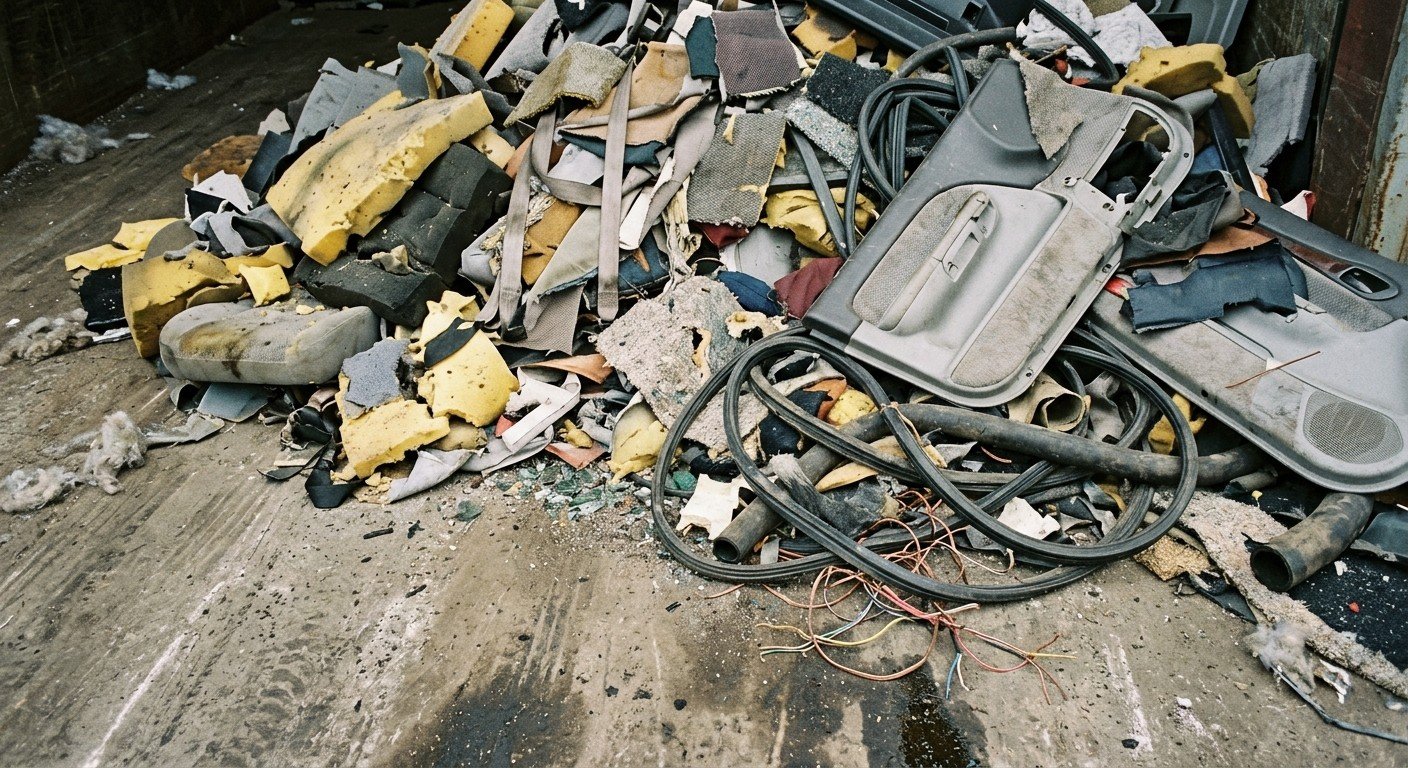
Automotive Shredder Residue (ASR) and its Valorization
ASR (Automotive Shredder Residue) is the residue from shredding vehicles and automotive scrap: the remaining fraction composed of plastics, rubber, glass, textiles, foams and residual metals.
In a scrap shredding line, these materials remain trapped in metal pieces or mixed into the flow. ASR separation plants combine low-speed shredding, magnetic separation, size classification and air separation to recover ferrous and non-ferrous metals and direct the light fraction to RDF production.
The opportunity is to turn ASR, today treated as disposal, into two revenue streams: recovered metals sold for recycling and a light fraction valorized as refuse-derived fuel.
5-Stage Process
1. ASR shredding — Line D
Vehicles and large automotive scrap are processed by Line D, homogenized to 50-100 mm with volumetric reduction of up to 70%. Low-speed ASR shredding (20-40 RPM) standardizes particle size, releases contaminants trapped in metal pieces and minimizes fines: high-speed shredders (hammermills) generate 30-40% fines; Line D generates less than 10%.
2. Magnetic separation
Magnetic separators (overband, magnetic drum or pulley) remove nails, screws, wires, steel fragments and ferrous hardware from the shredded flow. Extraction protects downstream equipment, increases final product purity and enables the sale of the metallic fraction as a by-product. See the Ferrous Metal Extractor →
3. Size classification — disc classifier
Rotating discs with adjustable spacing (20-80 mm) retain metals at the upper outlet while plastics, rubber, paper and glass fall between the discs. See the Disc Classifier →
4. Light/heavy separation — windsifter
The windsifter separates by weight difference and aerodynamic behavior with controlled airflow: the light fraction (plastic films, foams, textiles) is carried by the air; the heavy fraction (metals, glass, dense wood) falls by gravity.
5. Non-ferrous recovery
Conductive non-ferrous metals (aluminum, copper, brass, zinc) are recovered by eddy current separation. Small metal particles, below 10 mm, or with unfavorable geometry (wires, blades, flattened particles) require induction separation.
Fraction Destinations
| Fraction | Destination |
|---|---|
| Ferrous | Sold for recycling — magnetic extraction enables the sale of the metallic fraction as a by-product |
| Non-ferrous (aluminum, copper, brass, zinc) | Separated and sold for recycling |
| Light fraction (plastics, textiles, foams) | Energy valorization as RDF |
The ASR light fraction has a profile similar to the materials that make up RDF: contaminated plastics, textiles, rubber and foams. In the RDF production process, the fraction goes through sorting, inert removal, shredding and homogenization, with a final particle size typically of 20-80 mm for cement kilns. See the RDF page →
Equipment
- 2-shaft shredder — Line D: low speed (20-40 RPM), blades with replaceable inserts (50-100 mm width), hexagonal shafts with 4 bearings, PLC with automatic reversal. D690 model: 2x 200 hp, 1,392 x 1,905 mm cutting chamber, 690 mm rotors, 21,100 kg.
- Disc classifier — CDD Series: 1.5 m width, 2 m modules, 20 to 200 mm disc spacing, 10 to 20 hp, typical throughput of 5-15 t/h.
- Ferrous Metal Extractor: suspended electromagnet (overband), magnetic drum and magnetic pulley with high-intensity permanent magnets.
- ECS Separator: eddy current recovery of aluminum, copper, brass and zinc.
- Induction Separator: fine metal particles (below 10 mm) and unfavorable geometries.
- Windsifter: pneumatic light/heavy separation.
Jaguar specifies, validates, commissions and integrates the magnetic, ECS and induction separators. Each unit is certified by the engineering team for the project and sized to the material composition, which guarantees the reliability and results of the process.
Operator profile
- Automotive scrap processors with heterogeneous material who want to valorize every fraction, not only metals.
- Metal recyclers that currently landfill the ASR light fraction and want to turn it into RDF revenue.
- Vehicle dismantlers and recyclers that internalize processing to sell clean metals and a valorized light fraction.
- Waste management companies that produce RDF and want to increase metal recovery at the line inlet.
Frequently Asked Questions
What is ASR?
ASR (Automotive Shredder Residue) is the residue from shredding vehicles and automotive scrap: the remaining fraction composed of plastics, rubber, glass, textiles, foams and residual metals. An ASR separation plant recovers the metals from this mixture and directs the light fraction to energy valorization as RDF.
How does ASR shredding work?
ASR shredding is done at low speed (20-40 RPM) in Line D: shear cutting standardizes material size and releases contaminants trapped in metal pieces, generating less than 10% fines, versus 30-40% in high-speed shredders (hammermills).
What happens to the ASR light fraction?
The light fraction (plastics, textiles, foams) is separated by windsifter and disc classifier and directed to RDF production, valorized through co-processing in cement kilns.
Which machines does an ASR shredding line include?
The line combines the Line D 2-shaft shredder with magnetic separation (ferrous extractor), size classification (disc classifier), air separation (windsifter) and non-ferrous recovery (ECS and induction).
How are non-ferrous metals recovered from ASR?
Conductive metals (aluminum, copper, brass, zinc) are ejected by eddy current separation. Small particles (below 10 mm) with unfavorable geometry, such as wires and blades, are recovered by induction separation.
How do I specify an ASR separation plant?
Sizing starts from feedstock composition (vehicle and scrap mix), daily volume and fraction destinations: metals for recycling and light fraction for RDF. Throughput, particle size and separation stages follow from that, and Jaguar engineering sizes the line for your operation (contact us).