
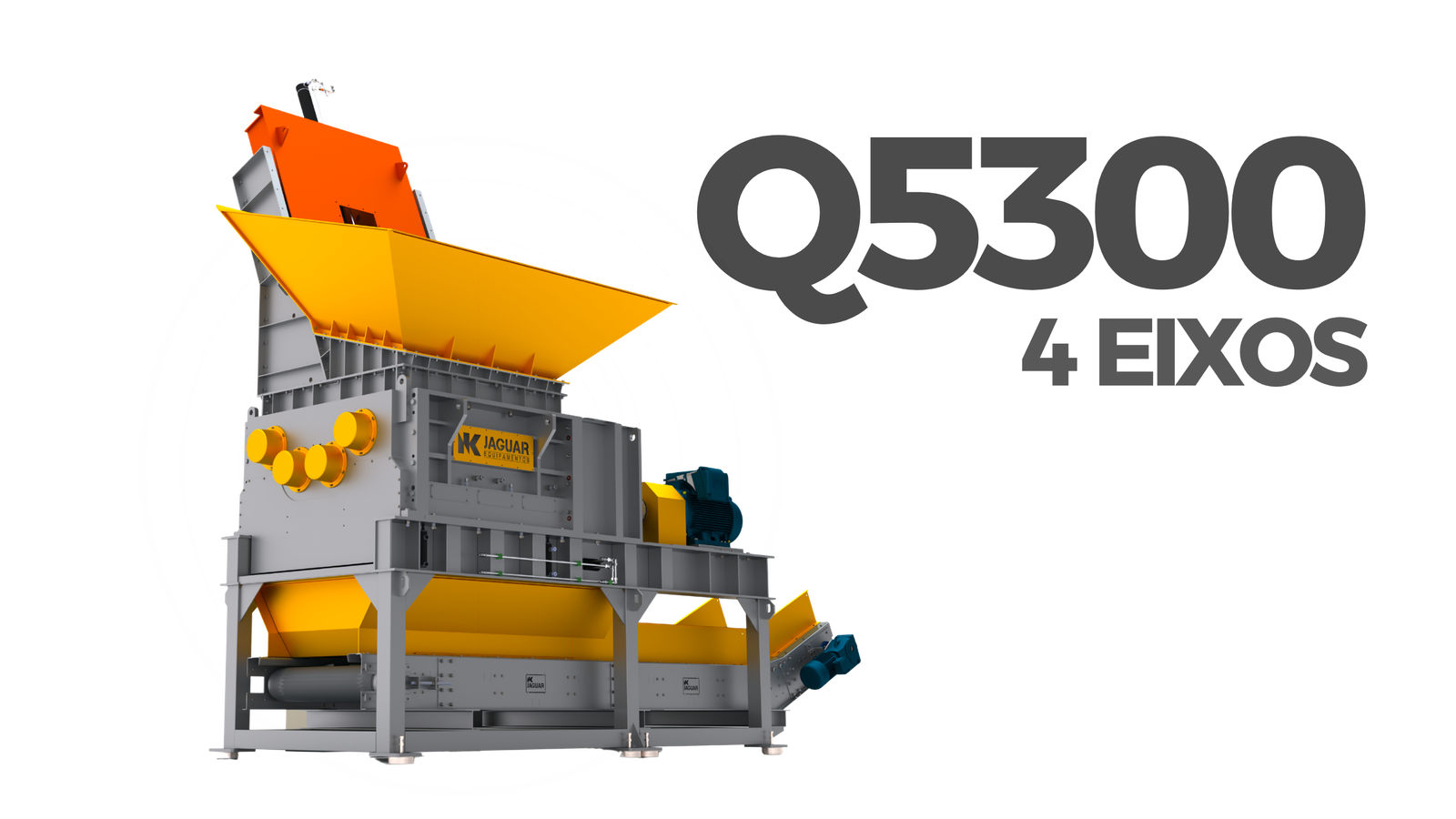
An RDF shredding line earns credibility from hours in operation, not from a drawing or a brochure. A solid waste treatment operation in Brazil’s ABC Paulista region — receiving more than 1,000 metric tonnes of waste per day — put a Jaguar Q5300 shredder to work as part of an RDF production line. Commissioning is complete, and the equipment has logged more than 2,000 operating hours in under four months. The client and its staff stay anonymous by agreement; the operating result does not.
That volume is also the problem this piece addresses: at more than 1,000 tonnes a day, no single machine carries an RDF line. What ships, and later runs, is a flow: characterization, pre-sorting, feeding, shredding, magnetic separation, electrical integration and automation, specified and tested together before commissioning starts.
Why the project starts with the waste, not the catalog
Before any equipment gets picked from a catalog, an RDF application starts with the material itself. Composition, contaminant load, moisture and input dimension define what the line has to do before they define what it will look like. Skip that step and the result is a shredder that runs, not necessarily a line that classifies, separates and delivers a fuel fraction a downstream buyer will accept.
For this project, the waste stream was the starting document. Everything that followed — screen opening, drive sizing, magnetic separation, control logic — traced back to what arrives at the plant, not to a standard configuration pulled off a shelf.
An integrated flow, not a single machine
The scope built around the Q5300 was never a stand-alone shredder — it included a pre-sorting platform ahead of it, one stage inside a longer process:
- Pre-sorting (sorting station): removes bulky, non-conforming or incompatible items before they reach the shredder, reducing feed variability and protecting downstream equipment.
- Feeding: an elevator delivers the sorted material to the shredder under the line’s control logic, reducing surges between stages.
- Shredding (Q5300, part of the Series Q line): reduces particle size and recirculates material against the screen, applying a tighter classification criterion to a heterogeneous stream.
- Magnetic separation (ferrous extractor): removes ferrous metal after shredding, protecting equipment further downstream and reducing metallic contamination in the RDF fraction.
- Electrical and automation systems: coordinate every stage so the line behaves as one process instead of machines operating in isolation.
Each stage controls a risk the previous stage could not: a bulky item that bypasses sorting becomes a shredder risk; an inconsistent feed rate becomes a classification risk; residual ferrous content becomes a downstream quality risk. Sequencing the stages this way, not buying machines separately, turns a shredder purchase into a working RDF line.
The engineering decision that mattered most: 100 mm to 76 mm
One decision recorded during the project shows how specification work happens. The screen — the perforated plate that sets the shredder’s classification opening — was originally specified at a 100 mm nominal opening. During development, the project team revised that specification to 76 mm.
This was not a cosmetic change. The screen opening determines how tightly the shredder classifies output before it leaves the machine. Moving from 100 mm to 76 mm tightens that criterion and brings the discharged material closer to the particle-size range the RDF application required. It does not mean every particle leaving the line measures 76 mm or less — actual granulometry still depends on the waste composition and how the material behaves as it passes through the process. What the change controls is the classification criterion itself, and that criterion had to be updated across the bill of materials (BOM), drawings and manufactured parts before the line could be built to the revised spec.
That is the difference between a catalog spec, fixed before the material is known, and an engineered one, revised until it matches the material that will actually run through the line.
Electrical, automation, testing and commissioning
Turning a revised mechanical spec into a working line meant integrating every system around the shredder: the elevator, electrical panel, variable-frequency drives (VFDs), cabling, motors, gearboxes, braking resistor and magnetic separator. Drawings, wiring, sensors and the bill of materials (BOM) had to describe one coordinated electrical and mechanical architecture.
Testing followed the same logic. The elevator was validated first in manual mode, then moved to automatic operation after the sensors defined in the electrical BOM were installed. Panel and drive specifications were checked against the adopted project standard before the line moved into commissioning.
Commissioning closed that sequence, confirming that the mechanical, electrical and automation systems worked together as one process rather than as separate systems installed side by side. From that point, the operation has run — and, in under four months, logged more than 2,000 operating hours.
What it takes to specify an RDF line
Projects like this one point to a consistent set of criteria that need to be defined before equipment gets selected:
- Composition of the incoming waste stream.
- Contaminant load, including materials to remove before or during processing.
- Moisture content, which affects both shredding and downstream handling.
- Input dimension, setting requirements for pre-sorting and feeding.
- Capacity and operating regime, matched to the volume the operation receives.
- Target particle size, defined as a classification criterion rather than a fixed guarantee.
- RDF destination, since the fraction’s end use shapes acceptable contaminant and moisture levels.
- Interfaces between stages — feeding, shredding, separation, electrical and automation — so the line behaves as one system.
The Q5300 served this project’s heterogeneous, loose-fed stream. When feed arrives in large pieces or bales, a PR4000/PR5000 pre-shredding stage is an alternative ahead of classification. It was not part of this project; its inclusion depends on the actual feed.
Seeing the line in operation
Operating hours show the result over time; video shows how the machine handles the material. The footage below records the Q5300 processing municipal solid waste for RDF production.
The Q5300 processing municipal solid waste for RDF production.
From specification to result
None of the individual decisions in this project — the pre-sorting scope, the screen revision, the drive sizing, the sensor logic — would mean much on their own. What produced a line that logged more than 2,000 operating hours in under four months was treating them as one connected specification, starting from the waste and ending at commissioning.
That is the same approach worth applying to any RDF line: define the material first, build the flow around it, test every interface, then commission the result. If your operation needs to specify or review an RDF line to that standard, talk to Jaguar’s engineering team.